
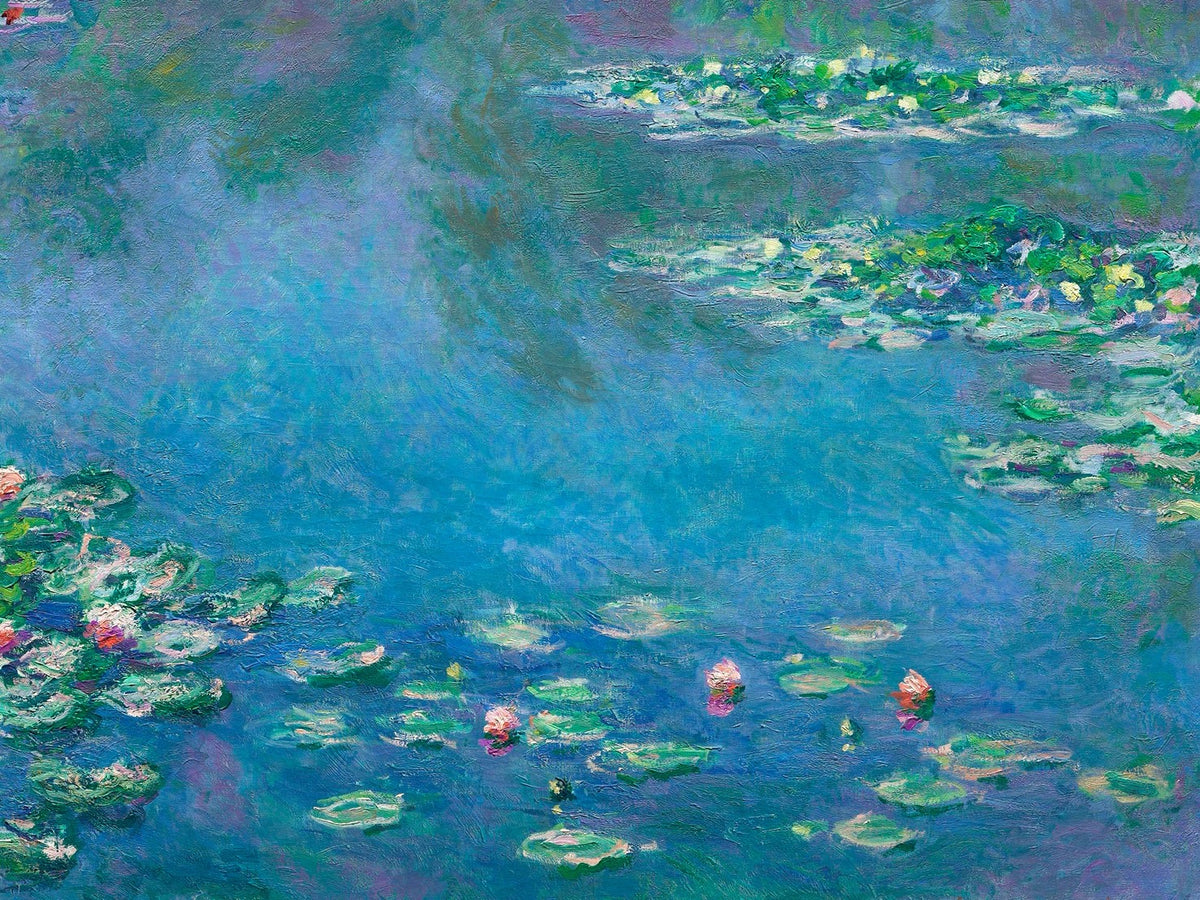
When looking at Monet's Water Lilies, first look for the leaves on the water's surface and the light reflected on it. Clusters of leaves indicate the position of the water's surface, while the surrounding pale colors and vertical brushstrokes provide clues to the water's depth and reflections. Water Lilies is used both as the title of a single painting and as the name for Monet's series of works on the same subject. Here, we will look at a 1906 painting from the Art Institute of Chicago.
View Water Lilies (1906) enlarged on the Art Institute of Chicago's artwork page
Where are you looking in the pond?
Step back slightly and find where the flowers and leaves are clustered first. The presence of leaves helps reveal the position of the water's surface within the layers of color. Next, move your gaze to areas where the leaves are sparse. There, you will find places where colors extend vertically and where boundaries are blurred. What is floating in the pond, and which colors appear to be reflected in the water? Using the leaves as landmarks makes it easier to move your eyes gradually.
When the horizon is not visible, how do you sense the expanse?
By not painting the edge of the pond and making the water's surface appear to continue beyond the frame, there are fewer clues to measure the foreground and background of the painting. Therefore, compare areas where the floating leaves are widely spaced with those where they are densely packed. If you follow them with your eyes to the edge of the frame, you will find places where colors and shapes break off at the border, making it feel as though they continue outside. How the artist cropped and presented a portion of the vast landscape is also one of the highlights of this painting.
Color and brushwork create the movement of the water's surface
If you were to choose one color that feels like water, you might think of blue. In this painting, the colors shift between blue, purple, and green tones in different areas, and short touches of paint resonate with nearby colors. Compare the areas around the flowers with those with few leaves, and look for places where bright colors are placed as dots and where they continue like bands. The mixture of areas with clearly defined shapes and those where boundaries disappear causes your gaze to move across the water's surface.
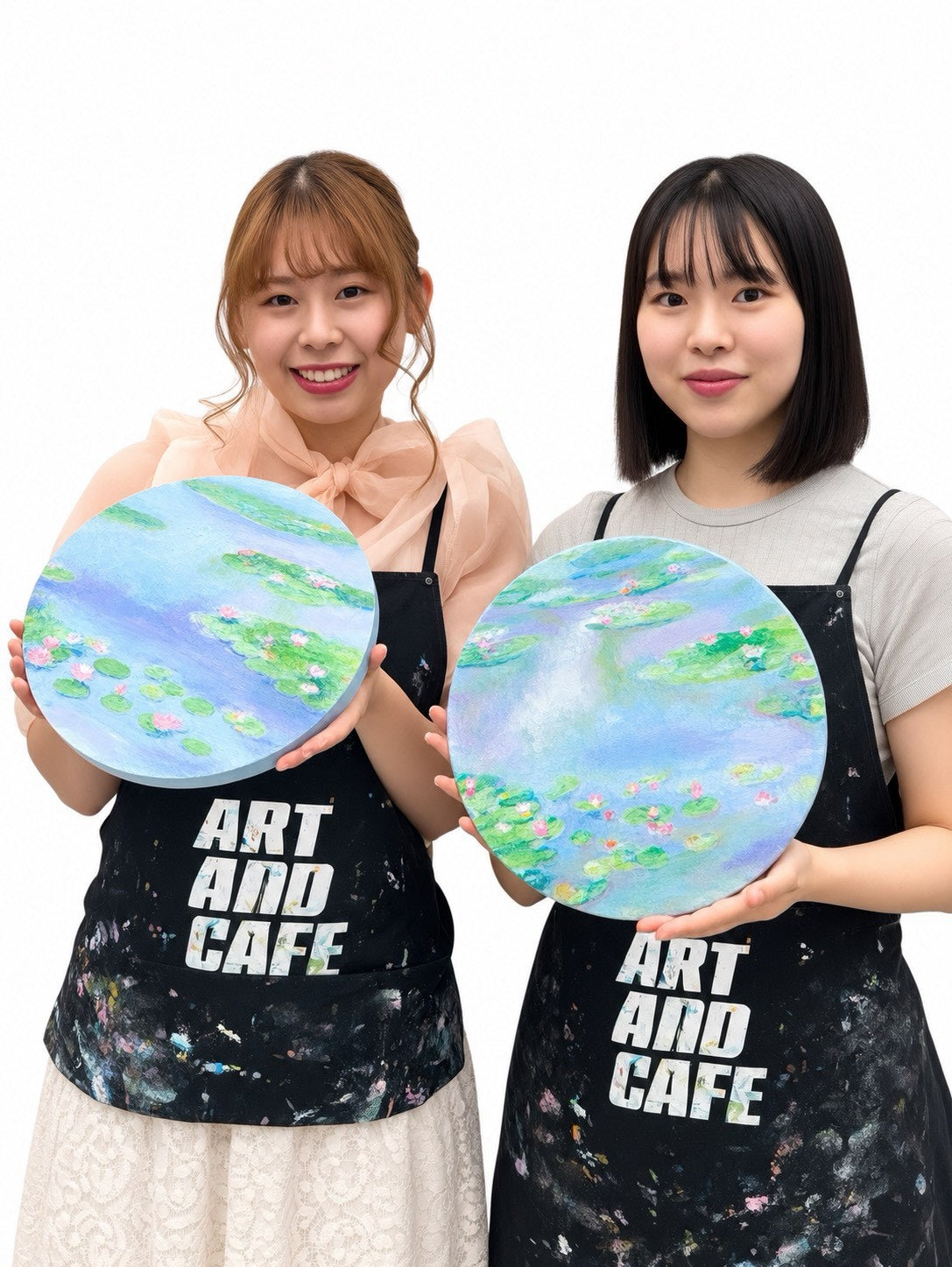
If you want to try placing colors yourself, you can choose the theme Water Lilies at ART AND CAFE Shibuya's Monet painting experience and check the reservation calendar.
Distinguishing the water's surface and leaves on small paper
First, create the water's surface on thick paper using blue and purple. Add several short vertical brushstrokes, then place horizontal green lines further away. The vertical colors represent reflections, while the horizontal shapes represent floating leaves. If they are difficult to distinguish, make the leaf lines slightly darker and the water's surface lines longer. By making two examples—one with the leaves clustered in the center of the paper and one with them gathered to one side—you can see how the movement of your gaze changes even when using the same colors.
Add a small amount of flower color last. Compare placing three bright dots together with placing the three dots apart. A cluster of brightness may serve as a landmark, while separated dots may guide your eyes to the edges of the frame. Pressing the tip of the brush down creates a dot, while pulling it briefly reveals the direction of the petals. Look at the two examples side by side and consider which arrangement makes the water's surface feel more expansive.
Common questions when viewing
If they are all the same pond, what should I compare?
When viewing a different Water Lilies, first check the size and aspect ratio of the image. Next, choose just one element to compare, such as the position of the flowers, the color of the water's surface, or the direction of the brushstrokes. For example, even if the number of flowers is similar, the way your gaze moves changes depending on whether they are arranged along the edge of the painting or clustered in the center. Although the titles are the same, you can see how each painting is designed to draw your eye by looking at them one by one.
Can I still enjoy the brushstrokes when viewing a reproduction?
When looking at an image, first view the whole thing, then enlarge the image provided by the museum to look for where colors meet. See whether bright brushstrokes cross dark colors or whether the color underneath peeks through at the edges of colors. Enlarging an image is useful for following shapes. When you have the opportunity to see the artwork in person, you can also see how the overall impression of the image changes depending on its size and your distance from it.
Looking at reflections in Shibuya puddles
When walking through the city after rain, look at the edge of a puddle from a place that does not obstruct traffic. Look for areas where the pattern of the sidewalk is visible and areas where the sky or buildings are reflected. Simply changing your standing position can change the reflection you see, even if the edge remains in the same place. When painting, compare drawing a long line of bright color over a dark color with dividing the same length into short brushstrokes. Many broken colors may make the surface feel like it is rippling, while long, continuous colors suggest reflected buildings or branches.
Looking at your paper drawing from a distance helps you see whether you were able to distinguish the leaves floating on the water from the colors that appear to be in the background. If the two look like they are on the same plane, try changing only the darkness or making the difference between vertical and horizontal brushstrokes more pronounced. If you changed only one thing, you can reflect on which adjustment altered the appearance of the water's surface.
Sources and Related Articles
Art Institute of Chicago | Claude Monet, Water Lilies (1906)
Part 4: What Is Color・Part 6: What Is Abstract Art
Part 10: Developing a Way to Look at Art・Table of Contents for All 10 Parts
ART AND CAFE Shibuya | Monet Painting Experience Availability and Reservations